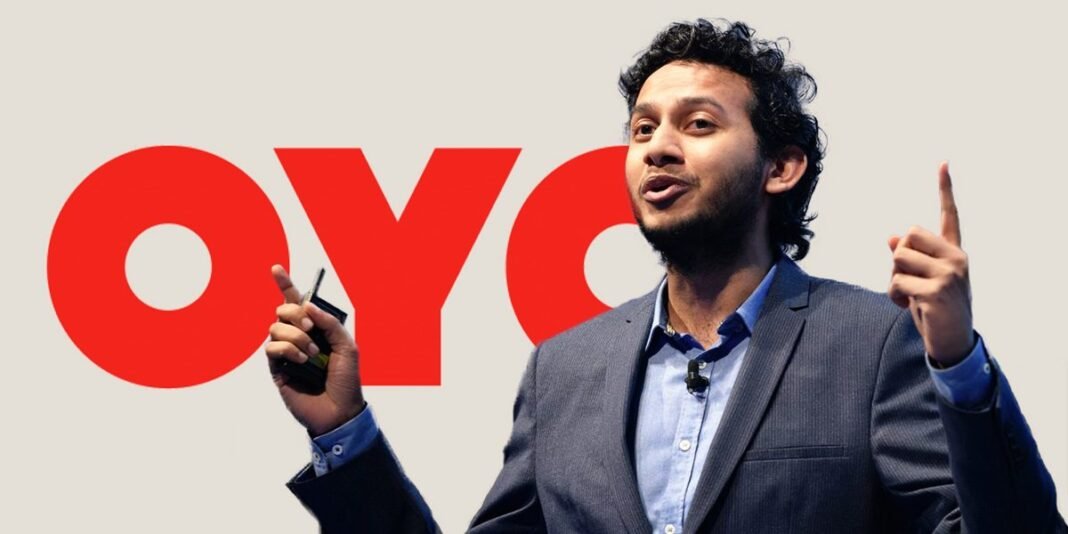
He arrived in Delhi with no college degree, slept in budget hotels to study their flaws, and convinced the world that a teenager from Odisha could reinvent how a billion people sleep.
Net Worth (2024): ₹1,900 Cr | Countries: 80+ | Founded OYO: Age 19 | First-Ever Profit, FY24: ₹229 Cr
There is a particular kind of stubbornness that looks like delusion right up until the moment it doesn’t. In 2012, a teenager from a small market town in Odisha was checking into yet another dingy budget hotel peeling wallpaper, a bathroom that smelled of old mildew, a ceiling fan that wobbled with each rotation. Most travellers would have complained in a review and moved on. Ritesh Agarwal pulled out a notebook and started writing. Not a complaint. A business plan.
That almost obsessive habit of studying failure of treating broken systems not as inconveniences but as invitations would eventually produce one of the most disruptive companies in the history of Indian entrepreneurship. But before OYO Rooms became a global name, before the billion-dollar valuations and Shark Tank appearances, there was a teenager who got told “no” more than a hundred times, dropped out of college before he had properly enrolled, and had the audacity to believe he could fix an industry he had absolutely no business fixing.
A Marwari Boy from the Margins
Ritesh Agarwal was born on November 16, 1993, in Bissam Cuttack a town so small it barely registers on most maps of Odisha. He grew up in Titilagarh, where his family ran a modest shop in Rayagada. The Agarwals were Marwari a community historically defined by a deep, almost genetic relationship with commerce. From the time he could observe, Ritesh watched his family navigate the rhythms of a small business: the early mornings, the ledger books, the careful management of inventory, and the relentless negotiation with uncertainty.
That early exposure to commerce didn’t make him a mini-businessman at seven. But it gave him something more durable: a comfort with the basic grammar of business. He understood, before he could articulate it, that value is created by solving inconvenience. He completed his schooling at Sacred Heart School and later St. John’s Senior Secondary School institutions that gave him a solid education, but not the kind of world that could contain the scale of what he was already imagining.
At thirteen, he was selling SIM cards. It wasn’t desperation it was practice. Even then, Ritesh was drawn to transactions, to the moment when someone hands over money because you’ve given them something they need. He moved to Kota, Rajasthan, briefly, to prepare for the IIT entrance exam a familiar rite of passage for ambitious Indian teenagers. But engineering by examination was never really the point. His heart was elsewhere, restless in a way that standardised tests couldn’t measure or satisfy.
The Move to Delhi, and the Education No University Offered
In 2011, Ritesh arrived in Delhi to attend college. He lasted long enough to understand that the classroom wasn’t the fastest path to where he needed to go. But those months in Delhi were not wasted they were an education of a very different kind. He had no money to spare, which meant he stayed in the cheapest hotels and guesthouses he could find. And night after night, in rooms that ranged from barely-acceptable to genuinely unpleasant, he noticed the same pattern: India had an enormous, underserved population of budget travellers students, salespeople, pilgrims, migrant workers and no reliable way to meet their most basic need of a clean, predictable room.
The problem wasn’t that budget hotels didn’t exist. They were everywhere. The problem was that walking into one was a gamble. The photos online when there were any bore little resemblance to what you actually got. Standards varied not just from city to city, but from floor to floor within the same building. Ritesh didn’t just observe this once and move on. He systematically stayed in budget hotels across India, cataloguing their failures, talking to their owners, understanding the economics of small hospitality from the inside. This was research of the most direct kind the kind you can only do if you’re willing to sleep in rooms that nobody else would voluntarily choose.
“The real problem wasn’t discovery it was trust. A traveller didn’t need help finding a cheap hotel. They needed to know the hotel would actually be what it claimed to be.”
Oravel Stays: The Necessary Failure
In 2012, at eighteen, Ritesh launched Oravel Stays essentially an Indian Airbnb equivalent, a platform to list and book budget accommodations. The company received early support from Venture Nursery, an accelerator program, and came with a grant of ₹30 lakh. On paper, it looked like a promising start. In practice, Oravel Stays ran directly into a wall that no amount of enthusiasm could immediately dissolve.
The core assumption that aggregating listings would be enough turned out to be wrong. Listing a hotel online didn’t make it better. It just made the disappointment more efficiently distributed. Hotel owners would sign up but baulk at any standardisation requirements. Customers would book based on photos, arrive to find something entirely different, and leave reviews that eroded trust further. The platform was functioning, but it wasn’t solving the underlying problem. Ritesh could have doubled down on the original model, as many founders do. Instead, he spent months examining exactly why it wasn’t working and that diagnosis became the seed of something far more ambitious.
The pivot he was formulating was radical: instead of being a marketplace that passively listed hotels, what if the company became an active operator one that went into hotels, standardised everything from the linens to the locking systems to the Wi-Fi password, and guaranteed a consistent experience under its own brand? This wasn’t just a product change. It was a completely different business, with completely different risks and requirements.
The Thiel Fellowship: A Hundred Thousand Reasons to Quit College
In 2013, Ritesh became the first Indian and one of only twenty young people globally to win the Thiel Fellowship. Founded by PayPal co-founder Peter Thiel, the fellowship was built on a contrarian premise: that the most talented young people were being kept in universities when they should be out building the future. The grant came with $100,000 and one condition the recipient had to stop attending college.
For most nineteen-year-olds, this would have been a terrifying proposition. For Ritesh, it was essentially permission. He took the money and used it to do something that had never quite been done at this scale in Indian hospitality: he signed a lease on a single hotel property in Gurgaon, put OYO’s branding on the door, trained the staff, standardised the rooms, and opened with a promise that every guest would get clean sheets, a working air conditioner, a reliable Wi-Fi connection, and a television predictably, every single time.
OYO which stands for “On Your Own” began not with a grand launch event, but with a single hotel and a theory. The theory was that trust, not price, was the real currency of budget travel. If you could make someone trust that a ₹999 room would reliably be a ₹999 room not a gamble, not a surprise you wouldn’t just earn their booking. You’d earn their loyalty. And loyalty, at scale, was the entire business model.
Building the Machine: Franchises, Technology, and Relentless Expansion
The OYO model that emerged from this theory was operationally complex in ways that its clean exterior deliberately concealed. Rather than building hotels from scratch, Ritesh’s team worked with existing property owners essentially offering them a bargain. OYO would train their staff, standardise their rooms, invest in tech infrastructure (including an app that handled all bookings), and bring them demand they could never have generated alone. In return, OYO took a share of revenue and controlled the guest experience entirely.
This franchising-plus-operations model was unusual. It required Ritesh to not just be a tech entrepreneur but to manage the very physical reality of hospitality the broken plumbing, the staff turnover, the linen that didn’t arrive on time. He was building, simultaneously, a technology company and an operations company. The tension between the two would define OYO’s growth for years.
Funding followed conviction. In its early years, OYO secured backing from Lightspeed India, Sequoia Capital India, and eventually SoftBank the Japanese conglomerate whose founder Masayoshi Son had a well-documented appetite for backing audacious founders with large cheques. By 2018, Ritesh had secured $1 billion in funding, a milestone that made him the youngest self-made billionaire in India at twenty-five.
Timeline
- 2011 Moves to Delhi; begins travelling across India and studying budget hotel failures firsthand.
- 2012 Launches Oravel Stays, an accommodation listing platform, with Venture Nursery backing. Identifies the critical flaw: listing doesn’t equal trust.
- 2013 Wins the Thiel Fellowship ($100,000 grant). Pivots Oravel into OYO Rooms. Opens first standardised property in Gurgaon.
- 2016 Named to Forbes 30 Under 30 Asia. OYO expands internationally for the first time.
- 2018 Raises $1 billion; becomes youngest self-made billionaire in India. Wins EY Entrepreneur of the Year.
- 2024 OYO reports its first-ever profit after tax ₹229 crore. Ritesh joins Shark Tank India Season 3 as the youngest investor on the panel.
The Reckoning: When the Company Nearly Broke Under Its Own Speed
Growth at the pace OYO achieved is a particular kind of danger. The company expanded so quickly into China, the United States, Europe, Southeast Asia that the operational discipline which had defined its early model began to stretch dangerously thin. By 2020, OYO was dealing with something that rapid-growth startups rarely plan for honestly: the consequences of their own ambition. Hotel partners in multiple countries alleged broken agreements. Employees were let go in large numbers. The COVID-19 pandemic, which devastated the global hospitality industry, hit OYO with particular force.
Read this:The Man Who Fed a Nation and Forgot to Eat
What followed was a painful but necessary restructuring. Ritesh made decisions that were unpopular in the short term reducing headcount significantly, pulling back from markets where profitability was structurally distant, and refocusing on the core markets where OYO’s model genuinely worked. The IPO plans were delayed, then delayed again. Critics who had celebrated the company’s rise found in its struggles a convenient narrative about the limits of hyper-growth. Ritesh, for his part, publicly acknowledged the errors. Not with the kind of corporate boilerplate that tends to accompany such moments, but with the directness of someone who had spent years learning by confronting uncomfortable truths about his own decisions.
The restructuring worked. By FY24, OYO reported its first-ever profit after tax ₹229 crore backed by eight consecutive quarters of positive adjusted EBITDA. The adjusted EBITDA itself grew by 215% to reach ₹877 crore, compared to ₹277 crore the previous year. Its parent company, PRISM, secured shareholder approval for a ₹6,650 crore IPO in late 2025. The company that had once looked like it might collapse under its own momentum had, quietly and methodically, learned how to sustain itself.
What Makes Ritesh Agarwal Different
There is a version of this story that presents Ritesh Agarwal as a genius who saw what others missed and executed flawlessly. That version is more flattering but less useful. The more honest version is of a person who made significant mistakes, corrected them with remarkable speed, and possessed an unusual willingness to learn in public to let his thinking evolve even when evolution required admitting he had been wrong.
His early habit of living inside the problem literally sleeping in the hotels he was trying to fix reflects something more than work ethic. It reflects an epistemic commitment: a refusal to theorise about a problem from a comfortable distance. This is relatively rare. Most founders, particularly as they scale, become increasingly separated from the actual experience of their product. Ritesh built OYO by staying uncomfortably close to it.
His leadership philosophy has a similarly direct quality. He has described the importance of surrounding yourself with people who are better than you at specific things not as a platitude, but as a practice. The early OYO team included people with deep hospitality expertise that Ritesh himself lacked. He was the vision and the sales pitch; they were the operational reality. That division of humility knowing what you don’t know and hiring to fill it is something many founders claim and far fewer actually practice.
The Ritesh Agarwal Mindset
He didn’t start with industry knowledge. He started with user frustration his own. That distinction matters. Industry veterans tend to see constraints first; outsiders see possibilities. Ritesh’s greatest early advantage was that he didn’t know enough about hospitality to believe it was unfixable.
The second, less-celebrated aspect of his approach is his tolerance for being wrong. He has publicly accepted responsibility for OYO’s overexpansion, spoken candidly about the company’s near-collapse, and framed these failures as the most important education of his career. In Indian startup culture, where failure still carries significant stigma, that candour is genuinely unusual.
Impact on the Industry and the People Most Often Overlooked
The conventional way to measure OYO’s impact is by the numbers: 800 cities, 80 countries, hundreds of thousands of rooms. These figures matter, but they obscure the more specific and more interesting story of what OYO actually changed.
For small hotel owners across India the ones running twelve-room guesthouses in tier-2 cities, the family-operated lodges near pilgrimage sites, the budget properties in highway towns OYO represented access to something they had never had: a distribution network, a tech platform, and a brand that could bring them guests from booking apps and credit card rewards programs they could never have integrated on their own. Whatever the complications that followed in some markets, this fundamental economic democratisation was real.
For budget travellers the vast, underdocumented majority of people moving around India for work, education, or faith OYO provided something that the premium hospitality industry had never bothered to offer them: reliability. A predictable room at a predictable price, bookable from a phone, without requiring a conversation with a sullen front desk clerk who may or may not have a vacancy depending on your negotiating posture.
Ritesh’s recent prediction that spiritual tourism will be one of India’s most significant hospitality growth drivers over the next five years is also worth noting. A 70% surge in bookings for holy destinations like Ayodhya on New Year’s Eve, surpassing established leisure destinations like Goa, is not a trend a typical hospitality executive would have spotted. It reflects precisely the kind of close-to-the-ground reading of Indian travel behaviour that has always been OYO’s core intelligence.
Net Worth and Business Scale
According to the Hurun Rich List of India 2024, Ritesh Agarwal’s net worth stands at approximately $225 million around ₹1,900 crore. At thirty-one, he ranks among the top ten youngest Indian billionaires. By 2018, at twenty-five, he had briefly crossed the billion-dollar threshold, making him the second-youngest self-made billionaire in the world at that time a distinction he earned not by inheritance or financial engineering, but by building a company that operated in the most tangible of all sectors: the physical experience of where people sleep.
OYO’s operational scale, as of FY24, includes presence in over 80 countries, properties across more than 800 cities, and a business that has now demonstrated, for the first time, the ability to generate sustained profit. The IPO preparations underway through PRISM represent the next chapter one that will subject the company to the rigorous scrutiny of public markets and, presumably, a new kind of accountability that Ritesh has spent the last few years preparing for.
Lessons From a Journey That Had No Roadmap
01 Study the failure, not just the opportunity. Ritesh didn’t just see a market gap he spent months understanding the structural reasons why the existing market was broken. That distinction is everything.
02 The pivot is not an admission of failure it’s proof of learning. Oravel to OYO wasn’t a capitulation; it was the application of real-world evidence to a thesis that had been only partially correct.
03 Rejection is information. Over a hundred investor rejections didn’t just produce resilience in Ritesh they forced him to sharpen his thinking, compress his pitch, and anticipate objections before they were raised.
04 Humility and ambition are not opposites. The arc of OYO’s story is inseparable from Ritesh’s willingness to say, publicly, that he got things wrong and then to actually change course rather than simply acknowledging it.
Conclusion
The most interesting question about Ritesh Agarwal biography isn’t how a nineteen-year-old from Odisha built a hospitality company. That part of the story, compelling as it is, belongs to the first half of his life. The more interesting question is what he does with everything that came after the collapse, the restructuring, the first profit, the pending IPO, the new role as an investor on Shark Tank mentoring a generation of founders who are watching his journey the way he once watched others’.
He has spoken about plans to set up five healthcare centres for underserved communities in Odisha a return, of sorts, to the place where the story began. That impulse suggests something beyond a company growth story. It suggests someone who has thought carefully about what building actually means, and who understands that the most durable enterprises are the ones that solve problems people didn’t know they needed solved, in places other people weren’t bothering to look.
India has produced remarkable founders. What makes Ritesh Agarwal’s success story worth studying is not that he succeeded, or even that he recovered after nearly failing. It’s that he has never stopped treating the problem in front of him as the most important one in the room whether that room was a dingy budget hotel in 2012, a SoftBank board meeting in 2018, or a Shark Tank pitch stage in 2024. That quality of genuine, undivided attention to the problem is, in the end, the one advantage that no amount of capital can fully replicate or replace.
Published on Aatmkatha.com · All figures sourced from verified public reporting and company filings. Net worth estimates are based on the Hurun India Rich List 2024.