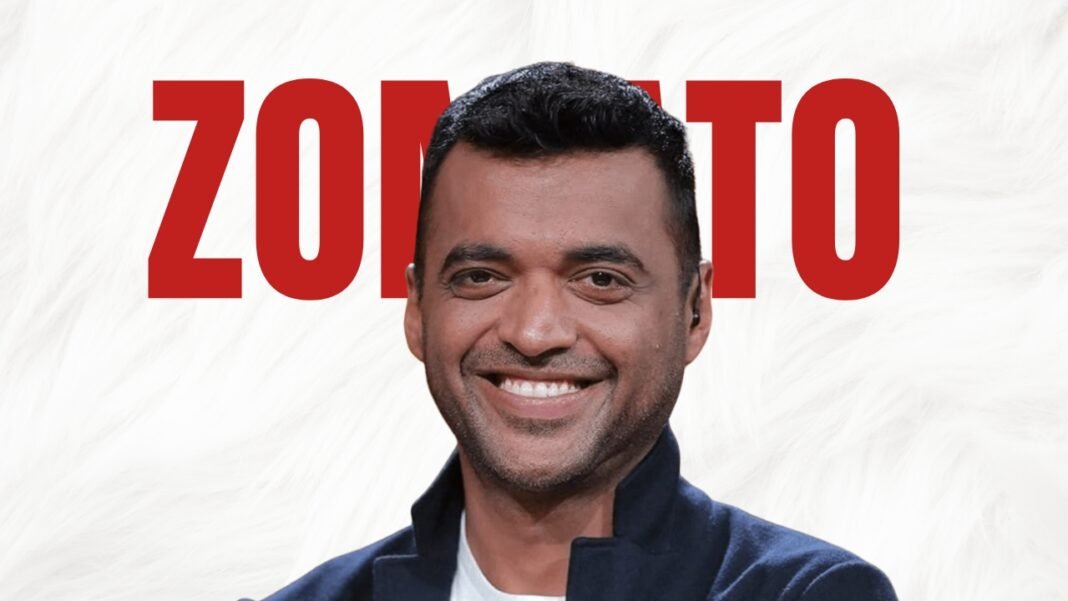
How Deepinder Goyal turned a lunch queue problem in a Gurgaon office into a $20-billion company and what it cost him along the way.
There is a poster that once hung above a messy desk in a paying-guest room in Chandigarh. Harbans Lal Goyal, a botany teacher from Muktsar, Punjab, saw it while helping his son pack for IIT Delhi. The words on it read: I was born to lead, not to be ruled. The father paused, stepped over a rogue sock, and said nothing. He had always known his son had fire. But he could not have imagined not remotely that the lanky, slightly arrogant boy leaving for Delhi would one day build a company that feeds more meals every day than any restaurant chain in the history of independent India.
This is the Deepinder Goyal biography not the sanitised press release version, but the honest one, tracing a journey from provincial obscurity through repeated failure, through one of India’s most audacious startup bets, to a seat at the top of India’s new-economy order.
Early Life: The Boy from Muktsar Who Was Never the Smartest in the Room
Muktsar is a small city in Punjab historically significant, economically modest, and entirely the kind of place where ambition has nowhere comfortable to sit. Deepinder Goyal was born there on January 26, 1983, to a family of educators. His father taught botany; his mother taught English. The household was stable, principled, and perhaps a little too honest about what the world expected from children who did not top their class.
For most of his early school years, Deepinder was not topping anything. He later recalled, with disarming frankness, that he was not well-liked by teachers and not particularly respected by peers. The classroom was not his natural habitat. Then, almost by accident a teacher transferred out, a test arrived, and desperation proved to be the finest tutor he ranked fifth in his class after a single night of preparation. Something shifted. Not a sudden burst of confidence, but a quieter realisation: he had simply not tried before.
The trajectory from that moment ran straight toward IIT. He was sent to Chandigarh for coaching, arriving in a city sharper and more competitive than anything Muktsar had prepared him for. At the National Talent Search camp, surrounded by students who had spent their entire childhoods preparing for this precise moment, he met Albinder Dhindsa a boy from Patiala who would become his closest friend, his first business partner, and, years later, the CEO of Blinkit. The two were inseparable from almost the first day.
He cleared the IIT-JEE on his first attempt and enrolled at IIT Delhi in 2001, choosing Mathematics and Computing — a combination that would prove to be less about academic passion and more about accident and aptitude. At IIT, the comparison was relentless and exhausting. Deepinder eventually decided, quite deliberately, to stop competing on other people’s terms entirely.
The Turning Point: The Lunch Queue That Changed Indian Food
After graduating in 2005 with an integrated master’s degree, Deepinder joined Bain & Company in Gurgaon as a Senior Associate Consultant. It was a prestigious landing the kind that satisfied families and impressed college reunions. He was good at the work. But he was also sitting in long queues every afternoon at the office cafeteria, watching colleagues flip through dog-eared paper menus trying to decide what to eat.
The menus were outdated. The process was tedious. Deepinder and his colleague Pankaj Chaddah another IIT Delhi graduate had the rare instinct to see a trivial problem as a scalable one. They scanned the menus of nearby restaurants, uploaded them to a website on the Bain company intranet, and shared the link with colleagues. Within days, the site was receiving more traffic than either of them had anticipated. The entire office was using it.
That moment a small act of convenience becoming an unexpected hit is the true origin of what would become Zomato. Not a grand vision. Not a pivot. Not a plan hatched over whiteboards. Just two hungry consultants who did not want to stand in a line.
In July 2008, they formalized the idea under the name Foodiebay a comprehensive restaurant directory for Delhi NCR. Within nine months, Foodiebay had become the largest restaurant directory in the city. In 2010, it was rebranded Zomato, partly to avoid any potential trademark conflict with eBay. The name had no special meaning; the momentum behind it was everything.
Building Zomato: From a Directory to a Delivery Empire
The early years of Zomato’s startup journey were powered by sustained manual labour. Deepinder and Pankaj built their restaurant database the hard way visiting restaurants, photographing menus, manually entering data, and convincing sceptical restaurant owners that being on an online platform was worth their time. It was not glamorous. It was just necessary.
The first significant outside capital came from Info Edge in 2010. With that backing, Zomato began expanding beyond Delhi first to Mumbai, then Bangalore, then international markets including UAE, South Africa, Canada, and New Zealand.
The entry into food delivery in 2015 was, by Goyal’s own admission, not strategic. It was survival. Swiggy was building aggressive delivery infrastructure; the market was moving in a direction Zomato either had to follow or cede. The company acquired Runnr, built out its delivery fleet, and transformed from a restaurant guide into a full-stack food-technology company almost overnight.
Key milestones in Zomato’s company growth:
- 2008 — Foodiebay.com founded. Becomes Delhi NCR’s largest restaurant directory within nine months.
- 2010 — Rebranded as Zomato. First investment from Info Edge. International expansion begins.
- 2015 — Enters food delivery. Acquires last-mile delivery service Runnr.
- 2018 — Achieves unicorn status ($1B valuation). Rival Swiggy raises $1 billion; Zomato has $35 million in the bank.
- 2020 — Acquires Uber Eats India. Deepinder donates ₹700 crore in stocks for delivery partners’ children’s education.
- 2021 — IPO raises ₹9,375 crore, listed at 50% premium. First Indian food-tech unicorn to go public.
- 2022 — Acquires Blinkit for ₹4,447 crore. Widely questioned at the time; becomes Zomato’s crown jewel.
Growth, Challenges, and Scaling: The Year That Nearly Broke Everything
By 2018, Zomato had become a unicorn. But valuations are a story told by spreadsheets; the operational reality that year was considerably darker. Swiggy raised a billion dollars. Zomato had $35 million. Goyal has spoken candidly about that period, describing it without nostalgia as simply “bad.” The gap was not just financial. It was psychological the sense that a rival had found a gear you did not know existed.
The pandemic years brought a different kind of pressure. The food delivery market boomed, then plateaued. The IPO in 2021 introduced a new internal problem: some employees, having made substantial money from the listing, began to lose the urgency that had defined the company. Goyal noticed something uncomfortable when he left the office early, the culture followed him out the door.
Then came Blinkit. In 2022, when Zomato’s stock price was taking a beating, Goyal acquired Blinkit then a loss-making grocery delivery company for ₹4,447 crore in an all-stock deal. Nobody understood it at the time. Analysts were sceptical. Shareholders were uneasy. But Goyal had spent six months embedded in Blinkit’s operations before the deal, studying the numbers from the inside. He later described it simply as “survival instinct.” By 2024, Goldman Sachs valued Blinkit at more than Zomato’s original food delivery business. The quiet bet had become the company’s biggest asset.
“What’s the point of worrying about what you can’t control? Better get an extra hour of sleep.” — Deepinder Goyal, on competitor IPOs
What Makes Deepinder Goyal Different
Deepinder Goyal is not the kind of founder who fills conference halls with optimism. He is not a natural orator, not a prolific tweeter of wisdom, not someone who manufactures a public persona with any visible effort. He describes himself with a certain wry self-awareness as someone others often find arrogant and difficult to reach. “Deepinder is arrogant. He doesn’t want to talk to people,” he has said of himself, almost cheerfully. The honesty is itself part of the character.
What sets him apart is an unusual combination: a refusal to think short-term, an almost eerie tolerance for being wrong in public, and a genuine lack of interest in being liked. His management style is blunt to the point of being uncomfortable. He has described pushing certain leaders to what he calls “rock bottom” before pulling them back up. He told Albinder Dhindsa to step down twice after the Blinkit acquisition, when integration was stalling. Dhindsa stayed. Blinkit grew.
He holds a love for poetry and books alongside his role as a technology executive. He donated ₹700 crore worth of stocks during the pandemic to fund education for the children of Zomato’s delivery partners. He has invested in over sixteen startups, appears as a judge on Shark Tank India, and has written on workplace culture.
Net Worth and Business Scale
As of 2024–25, Deepinder Goyal’s net worth is estimated at over ₹8,300 crore (approximately $1 billion+), making him one of India’s youngest billionaires. He holds approximately 4.24% of Zomato’s equity around 36.95 crore shares.
Zomato’s consolidated market capitalisation has crossed $29 billion. The company operates across 24+ countries, serves 100 million+ monthly active users, and runs Blinkit’s network of over 10,000 dark stores. Zomato’s gross revenue grew 68.9% year-on-year in FY23. The company achieved sustained profitability across four consecutive quarters a milestone that took fifteen years to reach.
Impact on the Industry
The story of Deepinder Goyal’s company growth matters for reasons that go well beyond the financial metrics. Zomato did not invent food. It did not invent delivery. What it did was fundamentally change the relationship between Indian cities and the act of eating. It gave hundreds of thousands of delivery workers a livelihood in an economy that had no formal structure for them. It gave small restaurant owners in tier-2 cities a market they could not previously access.
That impact is imperfect. The gig economy has real costs Goyal has been among the louder founders to acknowledge this, even as his own platform relies on it. But the company’s durability, in one of the most competitive and capital-intensive industries in the world, is not accidental. It is the product of a founder who prioritises long horizons over quarterly applause, and treats failure as data rather than verdict.
Lessons from the Journey
The most transferable lesson from Deepinder Goyal’s success story is also the least comfortable: patience is not passive. He waited fifteen years to show sustained profitability. He held his position when analysts questioned the Blinkit acquisition, when the stock fell, when employees grew complacent after the IPO. In each case, he was actively working against the grain of external pressure while maintaining an internal conviction about where the market was heading.
There is also something instructive in the origins a problem so small it barely qualified as a problem. A paper menu, a long queue, two hungry analysts with access to a scanner. The idea behind Foodiebay was not a disruption thesis. It was an annoyance solved. The lesson: the problems worth solving are not always the ones that sound important in a pitch room. Often, they are the ones you run into personally, every day, that everyone else has learned to accept.
And perhaps most quietly: Goyal never built a persona to fit a founder archetype. He remained exactly the person who once lived in a chaotic Chandigarh PG room with a motivational poster above his desk sharp, a little unreachable, more interested in building than in being seen to build.
The Unfinished Story
Deepinder Goyal is 42. Zomato rebranded parent entity Eternal is still growing, still absorbing new verticals, still betting on quick commerce in a country where consumer habits are shifting faster than infrastructure can keep up.
But the most interesting chapter of this biography has not been written yet. It is being written now in dark store logistics, in electric delivery fleets, in the AI-powered personalization of what a billion-plus people choose to eat. The boy who never wanted to be in the rat race is, in a deep irony, now setting the pace for one of the most contested races in Indian business. The difference is that this time, it is entirely on his own terms.
Published on Aatmkatha.com — Biographies That Matter.